Building a PR Complexity Score Bot with GitHub Webhooks
This is the third post in my Automating GitHub Reviews series, where I build small tools that make pull request reviews easier to prioritize and understand.
If you missed the previous parts, check them out here:
- Building an AI-powered GitHub PR Reviewer Bot – Automatically reviews PRs with OpenAI.
- Automating PR Descriptions with OpenAI and Vercel – Generates clear, structured PR descriptions.
Today, we’re taking it a step further by introducing a PR Complexity Score bot.
Why Does PR Complexity Matter? 🎯
Not all pull requests are created equal. Some are small and easy to review, while others are massive, difficult to understand, and prone to bugs.
Code Complexity Affects:
- Review Time – Large, complex PRs take longer to review and often introduce mistakes.
- Merge Confidence – High-complexity PRs are riskier to merge.
- Code Maintainability – Complex code is harder to refactor, debug, and extend in the future.
Our Solution 🔍
The PR Complexity Score Bot analyzes a few visible signals and assigns a score from 0–10, giving reviewers a quick indication of review effort before they open the diff. It is a heuristic, not a quality metric or a replacement for engineering judgment.
How the PR Complexity Score Works 🛠️
Our bot will:
- ✅ Listen for PR events (opened, ready_for_review).
- ✅ Fetch changed files, lines added/removed.
- ✅ Calculate Cyclomatic Complexity (measuring logical branching).
- ✅ Assign a complexity score (0-10) based on weighted factors.
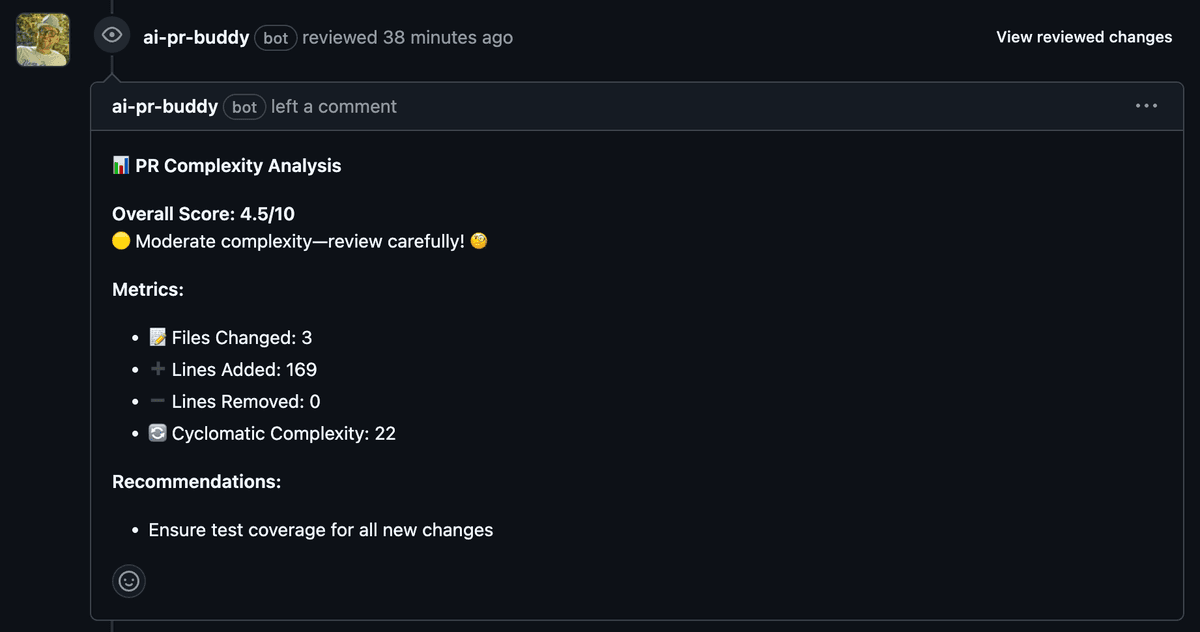
- ✅ Post a comment on the PR with a structured breakdown.
🔢 What is Cyclomatic Complexity?
Cyclomatic Complexity measures the number of independent execution paths in the code. More branches (if/else, loops, switch cases) → harder to read, test, and maintain.
Example:
1function canAccessFeature(user) {2 if (!user) {3 return false; // Decision 14 }5 if (user.role === "admin") { // Decision 26 return true;7 } else {8 if (user.subscription) { // Decision 39 if (user.subscription.active) { // Decision 410 if (user.permissions.includes("feature_access")) { // Decision 511 return true;12 }13 }14 }15 }16 return false;17}
What’s Wrong?
- Too many nested if statements (4 decision points → Cyclomatic Complexity 5)
- Hard to scan & debug
- Any small change increases the risk of breaking something
Let’s flatten the logic and use early returns to make the function more readable:
1function canAccessFeature(user) {2 if (!user) return false;3 if (user.role === "admin") return true;4 if (!user.subscription?.active) return false;5 return user.permissions.includes("feature_access");6}
Why This is Better?
- ✅ Cyclomatic Complexity reduced from 5 → 2
- ✅ No deep nesting → Easier to read
- ✅ Less chance of errors → Easier to maintain
Let’s Build It! 🚀
1️⃣ Setting Up the Project
1mkdir github-pr-complexity-bot2cd github-pr-complexity-bot3npm init -y4npm install @octokit/rest dotenv express
This installs:
- **@octokit/rest **→ GitHub API client
- dotenv → Manage API keys
- **express **→ Handle webhook requests
2️⃣ Writing the Webhook Handler
Inside the project, create an api/ directory:
1mkdir api2touch api/webhook.js
Add the following GitHub webhook handler to api/webhook.js:
1const express = require('express');2const { Octokit } = require('@octokit/rest');3const { computePRComplexityScore, calculateCyclomaticComplexity } = require('../utils/complexity');45const router = express.Router();6const octokit = new Octokit({ auth: process.env.GITHUB_TOKEN });78router.post('/webhook', async (req, res) => {9 try {10 const { pull_request, repository, action } = req.body;1112 if (!pull_request || !['opened', 'ready_for_review'].includes(action)) {13 return res.status(400).send('Not a relevant PR event');14 }1516 const owner = repository.owner.login;17 const repo = repository.name;18 const prNumber = pull_request.number;1920 // Fetch PR Files and Changes21 const { data: files } = await octokit.pulls.listFiles({ owner, repo, pull_number: prNumber });22 const totalFilesChanged = files.length;23 const totalLinesAdded = files.reduce((sum, file) => sum + (file.additions || 0), 0);24 const totalLinesRemoved = files.reduce((sum, file) => sum + (file.deletions || 0), 0);2526 // Compute Cyclomatic Complexity27 const fileDiffs = files.map(f => f.patch || '').join('\n');28 const cyclomaticComplexity = calculateCyclomaticComplexity(fileDiffs);2930 // Compute PR Complexity Score31 const prComplexity = computePRComplexityScore({32 filesChanged: totalFilesChanged,33 linesAdded: totalLinesAdded,34 linesRemoved: totalLinesRemoved,35 cyclomaticComplexity36 });3738 // Post a Comment on the PR39 const complexityComment = `40📊 **PR Complexity Score: ${prComplexity}/10**41- 📝 **Files Changed:** ${totalFilesChanged}42- ➕ **Lines Added:** ${totalLinesAdded}43- ➖ **Lines Removed:** ${totalLinesRemoved}44- 🔄 **Cyclomatic Complexity:** ${cyclomaticComplexity}4546🚀 **What This Means:**47${prComplexity < 4 ? '🟢 Low complexity—should be easy to review ✅' : prComplexity < 7 ? '🟡 Moderate complexity—review carefully! 🧐' : '🔴 High complexity—consider breaking this into smaller PRs! ⚠️'}48`;4950 await octokit.issues.createComment({ owner, repo, issue_number: prNumber, body: complexityComment });5152 res.status(200).send('PR Complexity Score added');53 } catch (error) {54 console.error(error);55 res.status(500).send('Something went wrong');56 }57});5859module.exports = router;
3️⃣ Calculating the PR Complexity Score
Higher complexity → Higher score (0-10)
We assign weights to:
- Files changed → 2 x weight
- Lines added/removed → 1 x weight
- Cyclomatic Complexity → 3 x weight
1function computePRComplexityScore({ filesChanged, linesAdded, linesRemoved, cyclomaticComplexity }) {2 const weightFiles = 2;3 const weightLines = 1;4 const weightComplexity = 3;56 const scoreFiles = Math.min((filesChanged / 10) * weightFiles, 10);7 const scoreLines = Math.min(((linesAdded + linesRemoved) / 500) * weightLines, 10);8 const scoreComplexity = Math.min((cyclomaticComplexity / 10) * weightComplexity, 10);910 return Math.min((scoreFiles + scoreLines + scoreComplexity) / (weightFiles + weightLines + weightComplexity) * 10, 10).toFixed(1);11}1213function calculateCyclomaticComplexity(code) {14 const controlStructures = /(\bif\b|\belse if\b|\bfor\b|\bwhile\b|\bswitch\b|\bcase\b)/g;15 return (code.match(controlStructures) || []).length + 1;16}1718module.exports = { computePRComplexityScore, calculateCyclomaticComplexity };
4️⃣ Deploying & Testing
- Deploy to Vercel
- Configure GitHub Webhooks
- Open a PR and see the bot in action!
You can check the demo PR with the bot in action here
5️⃣ What’s Next?
- Highlight functions with high complexity
- Use AI to suggest refactoring opportunities
- Integrate with GitHub Checks API for a status badge
Check out the full project here! 🚀

Michał Winiarski
Founder of Devbrains and senior software developer